By Imran Kamyana
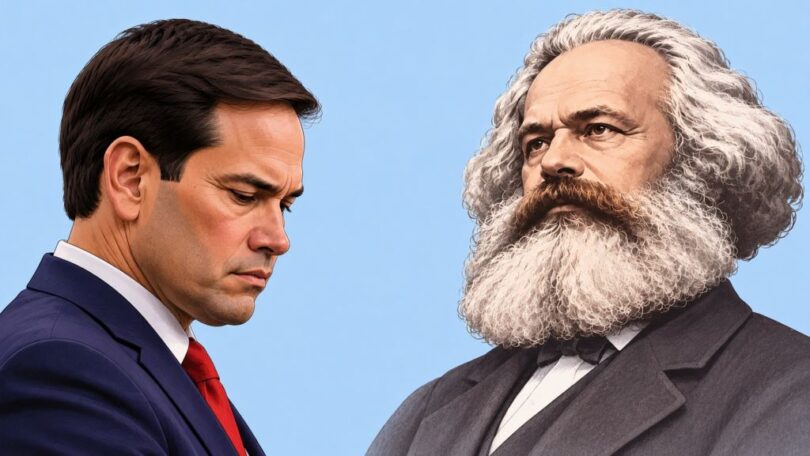
U.S. Secretary of State Marco Rubio has remarked in a speech that although the Soviet Union has collapsed, Marx’s ideas and thought remain alive to this day. Addressing a national lawyers’ convention organised by the Federalist Society, one of the most influential conservative legal organisations in the United States, Rubio stated:
When our predecessors first arrived in North America, when they first came, there were no factories, there were no railroads, there were no skyscrapers. These things exist because we built them, because we acted. (Applause.) These things exist because we acted without fear or moral doubt and overcame all that which threatened or stood in our way.
But today we are told by some that the age of great nations pursuing great destinies is over, that we cannot act, that we cannot impose ourselves upon the world, that we must surrender our dreams to the consensus of distant tribunals and submit to our place as merely one nation among the many, that we must accustom ourselves to the comfortable and to quiet decline. We are told that our determination to act in our own interests, on our own terms, is an assault on the universal, quote-unquote, “rules-based order.”
For example, under this theory, the President himself cannot execute the foreign policy of the United States, he cannot restrict trade or immigration or even examine the way in which we spend our citizens’ tax dollars abroad, without facing the fury of international lawyers and jurists and NGOs and UN bureaucrats condemning his threats to… condemning his threats to global values and norms.
All of this, at home and abroad, is a child of the leveling and pessimistic spirit of the age. It entices us to relinquish responsibility for our own destiny and to relieve ourselves of the burdens of greatness and seek refuge in these glittering generalities of international law. Even as we defeated the institution of Soviet communism, we did not triumph over the spirit of Marx. That spirit of Marx, it lives. It lives on in these new forms and doctrines, which would subordinate the national will to the menial consensus of the world. Marxism sought to abolish the distinctions between men. The radicals of our time seek to abolish the distinctions between nations themselves.
In the given context, Rubio’s reference to the ‘spirit of Marx’ is better understood as an allusion to the ‘spectre of Marx’. In any case, Rubio’s words of warning received little attention or coverage in the international mainstream media, and it is not difficult to discern why. In the present international situation, characterised by wars, intensifying inter-imperialist contradictions, the disintegration of the liberal order, a succession of mass protests, economic decline and growing instability, many statements and commentaries tend to be pushed into the background, particularly those that may not appear to be of immediate significance or do not directly address the burning issues of the day.
In this regard, the infighting between the liberal right and the far-right, which has emerged as a significant force in recent years, within the ranks of global imperialism itself cannot be overlooked. This rivalry is also reflected in the international mainstream media. Far-right figures like Trump have a habit of branding even their right-wing opponents as ‘communists’. Marco Rubio’s remarks, to some extent, fall into the same category. So, such statements obviously contain an element of accusation and exaggeration.
Nevertheless, particularly in light of the unending succession of massive movements involving students, workers and other popular layers across the world since 2008, as well as the emergence of new currents on the left, even when viewed through the eyes of the ruling classes, the spectre of Marx can certainly be seen looming over the world. Indeed, it is more visible than ever when viewed from the standpoint of serious bourgeois observers.
Perhaps more important than all these factors is the fact that the ruling classes, as a whole, seek (read: pretend) to ignore, as far as possible, serious ideological challenges to their system. This is essentially a longstanding historical practice: pretending not to take seriously any criticism that threatens to unravel the very fabric of an exploitative system. This practice has continued from the publication of Capital to the present day. The objective is to prevent revolutionary ideas from gaining traction (or, in other words, from becoming ‘mainstream’), in the hope that the passage of time will eventually bury them under its own dust. The ruling classes adopt the same approach towards revolutionary and resistance movements. But then they also extend this attitude to serious or potentially dangerous forms of self-criticism and internal warnings, seeking to ensure that what is said behind closed doors stays there. This does not mean that all of this is carried out through some highly secretive or conspiratorial mechanism (although certain operations and schemes certainly do go that far). Rather, the general practice is to speak between the lines, employ complex ‘professional’ language, and confine sensitive internal debates to prestigious and expensive journals and exclusive circles. At least, this is what bourgeois states and ruling classes seek to do, regardless of how fervently they profess their commitment to democracy, transparency and freedom of expression.
The everyday print and electronic media consumed by ordinary people, meanwhile, strives to appear as ‘neutral’ and non-ideological as possible. Consequently, it is equally superficial, and even its most truthful news reports ultimately amount to one gigantic lie. It therefore becomes an art in itself to examine the statements of policymakers and the political and ideological representatives of the ruling classes, to scrutinise the bourgeois media, and to draw conclusions by extracting information from it. Without this ability, no reasonable revolutionary perspective or strategy can be developed.
A class society is inherently pregnant with class warfare. Even when this warfare remains dormant for prolonged periods, it inevitably flares up sooner or later. And, as with any war, this one cannot be fought, let alone won, without keeping a close watch on the enemy’s strength, morale, confidence, planning and manoeuvres.
Marco Rubio’s remarks must also be examined in this context. (His entire speech is worth examining, but for the time being, we will confine our attention to the relevant excerpt.) Rubio is no secondary cog in the imperialist machinery. He is not only the U.S. Secretary of State but also the National Security Advisor, counts among Trump’s closest associates, and could emerge as a leading contender for the U.S. presidency after Trump.
Rubio began his political career as a relatively moderate Republican and was, at one point, even a critic of Trump. Over time, however, as circumstances changed, he increasingly gravitated towards Trumpism, whether as a result of opportunism, ideological conviction, or some combination of the two. Thus, apart from his reference to Marx, other aspects of his speech are equally worthy of attention. They reveal the material foundations, outlook and ambitions of the alternative and more extreme right-wing currents that have emerged in recent years.
For instance, the remarks quoted above amount, in effect, to an admission of capitalism’s historical bankruptcy and obsolescence. Without the slightest hesitation, he basically declared that the post-Second World War global liberal order, supposedly founded on ‘rules’, is hollow (“glittering generalities of international law”) and can no longer endure.
In making this argument, he invokes the historical struggles of his ancestors and the golden history of the United States. It hardly needs pointing out just how deeply this so-called golden history is stained with the blood of oppression and exploitation. It encompasses the ruthless genocide of the indigenous peoples of America; centuries of brutal oppression of Black slaves; the most ruthless exploitation of white workers themselves, as well as immigrants of every colour and ethnicity arriving from other parts of the world; and the plunder of human labour and resources across the globe.
Yet, with remarkable political cunning, Rubio has wrapped this entire history of crimes, contradictions, and unending oppression and exploitation in the mantle of a great American nation. As though think that these factories, railroads and skyscrapers had been built by Rubio’s ancestors through some harmonious process of benevolence, compassion and ‘national’ consensus, with everyone working together (‘we built them’).
Nevertheless, Rubio goes on to acknowledge that things are no longer what they once were: America is in decline, and the ‘…pessimistic spirit of our age’ is increasingly gaining ground. This is, in fact, the voice of a system whose own future looks bleak. Yet the very terms in which Rubio frames the problem also contain his supposed solution.
The essence of his argument is that, in order to ‘Make America Great Again’ and restore its golden age, the conditions that supposedly prevailed during that so-called golden era must be recreated. Just like Rubio’s settler-colonial ancestors, America must act ‘without fear or moral doubt’; it must treat ‘distant tribunals’, ‘international law’ and the United Nations with utter contempt; it must ‘impose’ itself ‘upon the world’ and act in its ‘own interests’, on its ‘own terms’ (as though it had never done so before!); the U.S. President must be granted virtually unlimited, authoritarian powers; restrictions must be imposed on trade and immigration; and the ‘national will’ must be placed above ‘menial consensus of the world’, i.e. above every value, law and regulation.
In other words, the global liberal order supposedly based on rules, which the United States itself created after the Second World War in collaboration with its imperialist allies, must be swept away. For an order that once served to advance American imperialist ambitions has now become an obstacle in their path (or perhaps it is simply unsustainable).
However, the problem is not confined to international laws, treaties, regulations and so on. Its key and far more serious dimension is the erosion of the democratic, gender and economic rights of working people—rights won through centuries of struggle. Climate change and environmental catastrophe are another case in point.
In the specific conditions that prevailed in the post-Second World War period, characterised by high rates of profit, powerful labour movements and the existence of the Soviet Union, the ruling classes were, to some extent, willing to grant these rights and concessions. But the situation today is different. Capitalism can no longer sustain itself without further intensifying the exploitation of the working class.
Rubio’s remarks are not merely proposals; they are part of an ongoing international project that Trump and his entourage are pursuing in collaboration with like-minded political currents in other countries. But this is not simply a matter of the subjective ambitions or aspirations of a particular ruling clique. Just as with the ‘spirit of Marx’, these far-right currents, too, are products of concrete material conditions and social contradictions.
On the one hand, the old, traditional or liberal right has failed to resolve the crisis of capitalism. On the other, the reformist left has proved incapable of offering an alternative to this crisis-ridden system. New currents have emerged on the left in recent years. Yet, despite projecting an image of radicalism, they have failed to move beyond attempts at reform. These efforts, too, have largely proved unsuccessful, because the scope for reforms within the system itself is steadily diminishing.
Consequently, these (seemingly) lesser evils of the right and the left have, to a considerable extent, converged, paving the way for greater evils.
A similar situation applies to the so-called consensus-based, rules-based liberal order, whose history is replete with imperialist aggression, wars, devastation, and unprecedented national and class exploitation. To the extent that any element of rules, regulations and consensus existed within this order, it rested on an understanding among the imperialist ruling powers themselves, along with their lackeys in the labour aristocracy and the mainstream left. Its purpose was not the welfare of the exploited masses, but rather to prevent the exploitative system from descending into uncontrollable instability and chaos.
However, the ongoing disintegration of this order is giving rise not to a new order but to a state of ‘disorder’, in which conditions are becoming increasingly horrific. Once China, Russia and the smaller regional powers that have recently emerged or begun pursuing relatively independent courses are factored into this equation, inter-imperialist tensions, along with the direct conflicts and proxy wars arising from them, become not only more widespread but also more complex and bloody. Nor do these conflicts show any signs of coming to an end (Palestine, Ukraine, Iran, Yemen, Sudan, etc.).
Consequently, a return to the old normal is virtually impossible, both at the national and international levels. Liberal or ‘moderate’ sections of the imperialist bourgeoisie and reformists certainly make efforts to restore the previous order, and may even achieve partial or temporary successes. At the same time, however, they are also busy planning and preparing for the new realities (Europe’s rearmament, China’s growing appeal as an alternative to the United States, new military alliances, and so on).
Yet it is also a fact that even in most countries where far-right governments are not in power, state repression and censorship are on the rise. In other words, what rulers like Trump do openly, deliberately and explicitly, other factions of the ruling classes are compelled to pursue in a relatively ambiguous, passive, covert and gradual manner. Ultimately, it is the imperatives of the system itself that determine policy.
But history is not simply shaped by the ambitions, plans and conspiracies of the ruling classes. Ultimately, it is class struggle that determines its course. The spectre of Marx is haunting the imperialists today precisely because protests are erupting, uprisings are breaking out and movements are emerging across the world—from Bangladesh, Nepal, Sri Lanka and Kashmir to France, Spain, Italy and Portugal, and from Chile and Bolivia to Brazil and Argentina.
Contrary to idealist conceptions of history, spirits do not descend from heaven, nor do they emerge out of thin air; they arise from material conditions. As long as classes exist, therefore, class struggle will continue. Marx’s spirit will continue to emerge from this class struggle, and the spectre of Marx will continue to haunt the ruling classes.
But this ever-intensifying nightmare of oppression and exploitation will come to an end only when Marx’s spirit permeates the consciousness of the oppressed and is transformed into a material force.